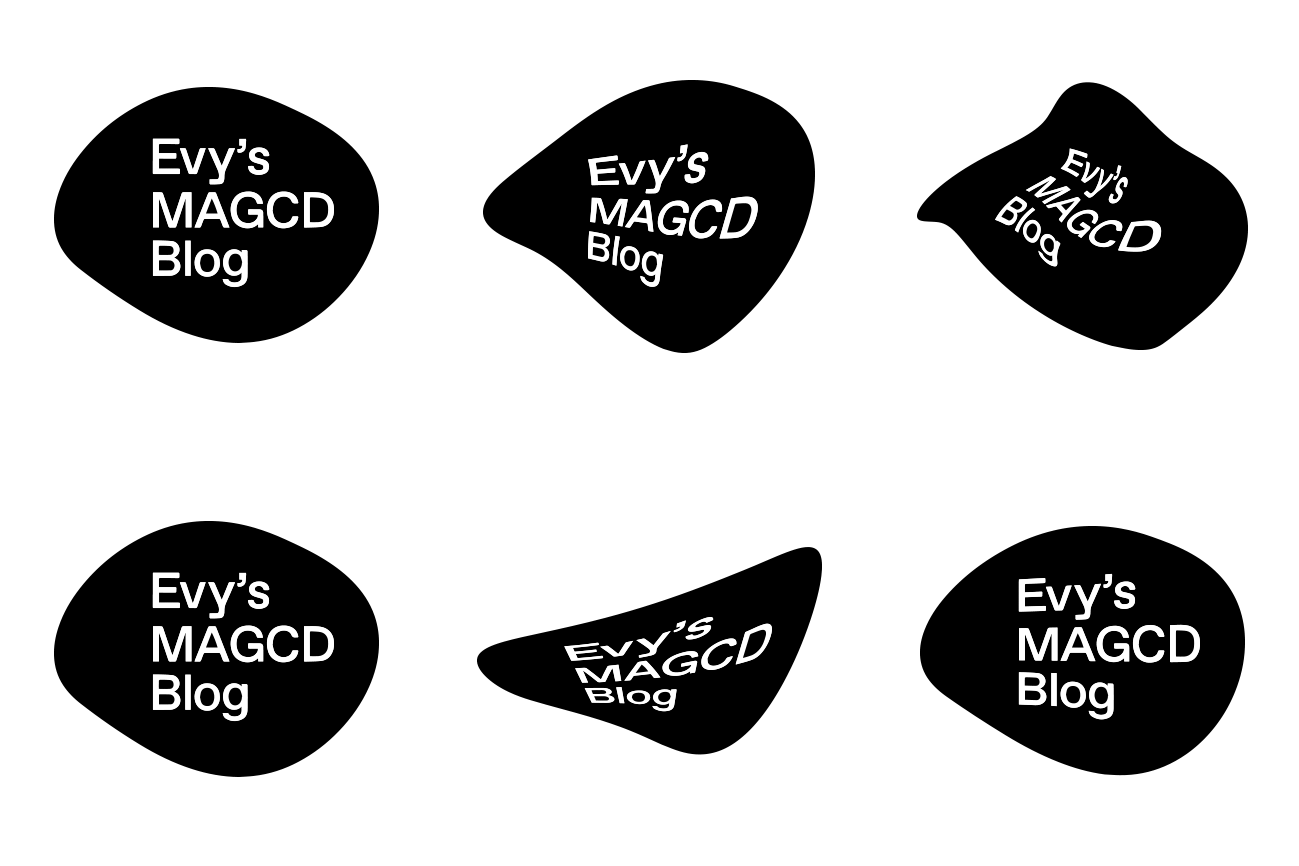
This last week of the project has been pivotal in the understanding and development of the concept I’ve been working on for last few weeks. As I thought about my project’s critical question, I realised that I was not only trying to explore Blender as a type design software, but I was in fact channelling my interest for the creation of visual systems into this project. My initial references included the work of Karl Gertsner with design systems and the creation of “programmes”. Some of these concepts echo in my current exploration and give a backdrop to my interesting in setting variables and constrains as fundamental parts of this project.
In this project, something so intrinsically mathematic as the plane graph, becomes a vehicle for the creation of a simple “programme”, that is just a micro environment in which iteration, change, transformation happen.
In order to organise and contextualise the amount of experiments and iterations developed through the project, I decided to experiment creating a “brochure” page, allowing me to play with animation and interaction, articulating the different elements behind the rationale and content within the project. This was mainly inspired by websites created by researchers at Strelka Institute (See Vault), using web publishing as a way to present research project in a dynamic and engaging way.
The complete project prototypes can be found here: https://www.figma.com/proto/73FxQM6VzoxkE3t8K1EURo/MAGCD-Methods-of-Iterating?page-id=0%3A1&node-id=0%3A1&viewport=47%2C-46%2C0.16&scaling=scale-down&starting-point-node-id=8%3A121&show-proto-sidebar=1

In this post, rather than presenting my work or discussing the process (which was introduced in a previous entry and is also available on the prototype), I aim to reflect on some of my findings and discuss around the open-ended development. This reflections also reflect my thoughts on the feedback received during the last group crit, and some points on how to take my practice forward.
Outcomes vs Systems –
Although isolated variables can create pretty wild visual responses, these are not in any way isolated from the general context. They exist within a system intrinsically set by the variables. Whether is a line, shape, letter or word, every element that is affected by the variables becomes part of a system, even if it was in nature different to the others.
I have thought about design systems before in a very linear and rational way before, but I didn’t imagine I could start to tap into it by using something like Blender. Like in the example below, after I started pushing beyond the boundaries of legibility, I encountered some interesting geometric patterns and visuals that are born from the set of constrains but come as a secondary iteration.
The input matters, so, what if I go further? –
Through the experiments I was mainly focused on the process and the way I could use blender to generate multiple iterations of the same thing in different states. But in the last week, after week 2 feedback session, I became more concerned with exploring the possibilities of customising the input, in a way that it could shape the results in more unexpected and anti-intuitive ways.
After using Blender’s built in text input for the first round of iteration, I went on trying to design the letterforms straight within blender. I encountered several constrains when drawing type. Although I was able to draw points and paths in a similar what to what is done in illustrator, the software would only recognise these as curves without any geometry or fill. Also, by having to draw every letter, I was limited in the way I could put text together as is a very time consuming exercise.
The concept and the packaging are a different matter –
Something I started to grasp with this brief is the difference between developing a concept or idea and contextualising in a way that is understandable through visual communication. As designers, we can aim for our concepts to be as anti-intuitive as we want, but when it comes to packaging, in my opinion, it’s worth producing hyper-intuitive interfaces. This is something I tried to articulate when developing the final visuals for this projects, as I navigated how to present this idea of change over time using simple language and visuals that could be interpreted by anyone outside of the design circle.
As a designer, I’m interested in building upon rich and profound concepts, but also in making them as accessible as possible to external audiences. This is the main reason why I decided to experiment with Figma and develop micro interactions within the page as a means to start exploring how anyone could interact with the content.
One system – Multiple outputs
There’s much more than letterforms that could be explored through the method. At the latest stage of this project, I have started looking at how different set of rules can affect geometry and create symbols, pattern, textures, etc. I believe there’s an interesting opportunity to bring more complex forms as the input as well as taking the outputs and reprocessing them in other sorts of software to be used in wider contexts.
Whether is through Blender, or through some other open-source software, I would like to push further in using technology to design “programmes” that can aid the creating of visual design systems.